If you are sourcing wear parts, tooling, or high-temperature components, the terms tungsten and tungsten carbide are often used as if they were interchangeable. They are not. Tungsten metal is the pure element: dense, ductile, and exceptionally resistant to heat. Tungsten carbide is a chemical compound of tungsten and carbon, and in practice it is almost always used as a cemented composite that is dramatically harder and more wear resistant. Choosing the wrong one can lead to premature failure, unnecessary machining cost, or a part that shatters under an impact load it was never designed to take. This guide explains where the two materials genuinely differ and how to decide between them.
Tungsten metal refers to the element tungsten (chemical symbol W) in metallic form, usually at purity levels of 99% or higher. It is produced by reducing tungsten oxide with hydrogen and then consolidating the powder through sintering, forging, or rolling. Its defining behavior comes from the metallic bond: atoms slide past one another under load instead of fracturing, which is what gives the material its ductility.
Key characteristics of tungsten metal include:
Its weakness is equally clear: tungsten metal is not especially hard. In an annealed condition it is comparable to hardened tool steel, so it wears relatively quickly in sliding abrasion or metal-cutting contact.
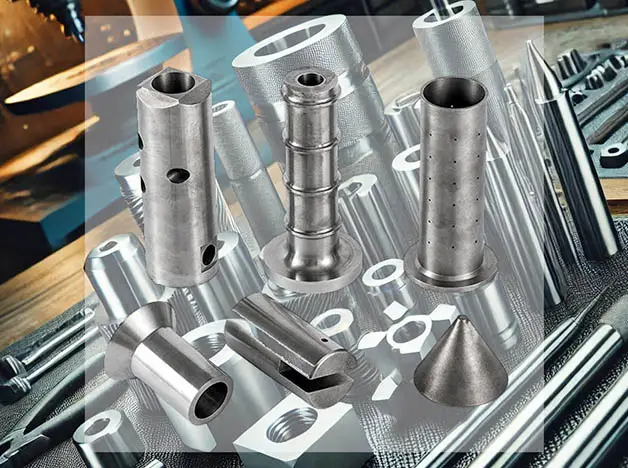
Tungsten carbide (WC) is formed by reacting tungsten powder with carbon at high temperature. The result is a ceramic-like compound with a hexagonal crystal structure, extreme hardness, and very limited ductility. Because pure WC is too brittle to serve as a structural part, it is almost always combined with a metallic binder, most often cobalt and sometimes nickel, and densified by liquid-phase sintering.
The resulting material, cemented carbide, behaves as a composite: hard WC grains locked inside a tougher metal matrix. Binder content is the main tuning variable. A low cobalt content of around 6% delivers maximum hardness and wear resistance, while higher binder levels up to 15% or more trade some hardness for impact toughness.
When a supplier quotes tungsten carbide, they are almost never quoting pure WC. They are quoting a grade defined by grain size, binder type, and binder percentage. Two parts sold under the same generic name can therefore perform very differently in service. Reputable suppliers such as Better Metal specify these parameters explicitly, so buyers know exactly which grade they are receiving rather than assuming all carbide is equivalent.
| Property | Tungsten metal (pure W) | Tungsten carbide (cemented WC-Co) |
|---|---|---|
| Composition | 99% or more tungsten element | WC grains plus 6–15% cobalt or nickel binder |
| Hardness | Roughly 300–500 HV depending on condition | Roughly 800–1,600 HV depending on grade |
| Density | Approximately 19.25 g/cm³ | Approximately 14–15 g/cm³ |
| Melting behavior | Melts at about 3,422 °C | Decomposes near 2,870 °C; not cast or welded |
| Toughness | Ductile; absorbs impact through deformation | Brittle; high compressive strength, low edge ductility |
| Thermal conductivity | About 173 W/m·K | About 80–120 W/m·K |
| Electrical resistivity | About 5.6 × 10⁻⁸ Ω·m | About 2 × 10⁻⁷ Ω·m |
| Magnetic response | Paramagnetic | Ferromagnetic when cobalt-bonded |
| Forming methods | Sintering, forging, rolling, wire drawing, welding | Powder pressing, sintering, diamond grinding, brazing |
| Cost drivers | Tungsten raw material plus fabrication labor | Raw materials plus sintering, binder content, and grinding |
Carbide wins decisively. A cemented carbide cutting edge or wear pad will hold its geometry far longer than tungsten metal under the same abrasive or sliding contact. For dies, seal rings, nozzles, and cutting tools, this hardness gap is usually the entire reason the material is specified.
Here the advantage reverses. Tungsten metal bends, dents, and absorbs shock. Carbide does not: it chips, cracks, and can shatter at an edge. If a component sees hammer blows, torsion, or unpredictable side loads, a lower-binder carbide grade may survive, but tungsten metal or a different alloy is often the safer choice.
Tungsten metal is roughly 25–30% denser than cemented carbide. When mass must fit into a fixed volume, such as counterweights, ballast, or shielding, tungsten metal allows a smaller package for the same weight. Carbide's combination of lower density and brittleness makes it a poor substitute in those roles.
Tungsten metal performs in vacuum or inert atmospheres at temperatures that would destroy most metals. Cemented carbide is far more limited: in air, cobalt-bonded grades begin to oxidize and lose strength above roughly 500–600 °C, and the binder softens well before the WC grains themselves would fail.
Tungsten metal can be machined with carbide tooling, threaded, welded, and formed. Cemented carbide cannot be machined conventionally; it is shaped by pressing and sintering to near-net form and then finished only by diamond grinding. It is typically attached to a steel body by brazing, clamping, or shrink fitting rather than welded.
Both materials track the tungsten raw material market, so neither is a commodity on price alone. For simple wear parts, carbide is frequently the more economical option because it lasts longer. For large, complex, or mass-critical components, tungsten metal often becomes cheaper once fabrication is included, since carbide geometry must be ground rather than cut.
Yes. Cemented carbide grades typically measure several times harder than pure tungsten metal on the Vickers scale, which is the core reason it dominates cutting and wear applications.
It is a compound of tungsten and carbon rather than a form of the metal itself. It contains a high percentage of tungsten by weight, but its properties, machining behavior, and failure modes are those of a cermet composite, not a metal.
No. Welding heat will degrade the cobalt binder and crack the material. Carbide is normally brazed to a steel support, mechanically clamped, or shrink fitted.
Tungsten metal, because shielding performance scales with density and the material can be produced in large, ductile, non-friable forms.
In short, tungsten metal and tungsten carbide solve different problems. Choose tungsten metal when you need density, ductility, heat resistance, or weldability. Choose tungsten carbide when the enemy is wear and the load is compressive. Matching the grade and the form of supply to the actual service conditions is what separates a component that lasts years from one that fails in weeks, and working with a supplier that documents grain size and binder content makes that decision far more reliable.
Share this page

If you have any product needs or questions, please leave us a message for consultation.
TEL: 86-18623759992
jason@bettmetal.com

Innovating Materials
for a Brighter Future